David Louis doesn't play guitar;he negotiates with silence. Spend five minutes with his 2019 album Lowlands and you'll notice the space between notes carries as much weight as the notes themselves. On the track "Ferry Crossing," he let a single sustained chord ring for nearly twelve seconds before resolving it—a move that would make most producers nervous. Louis told an interviewer it was an accident he decided to keep. That instinct, to trust the unresolved, defines his approach.His technical foundation is often misread. Critics lump him into the "post-bop" bin because he studied under a second-generation hard-bop drummer in Chicago. But listen to "Threadbare" from his 2021 trio record, and you'll hear something closer to folk minimalism than bebop velocity. He favors a 1959 Gibson ES-175 with flatwound strings, and his right-hand picking is unusually quiet—he often amplifies through a vintage Fender Princeton with the volume barely past two. In a live setting, this forces audiences to lean in. I saw him at a 150-seat club in Portland last year。and the room went so still during his solo on "Harbor Lights" that you could hear the espresso machine hissing in the back. That kind of dynamic control isn't taught in conservatories.Collaborations tell a scattered story. Louis has recorded with avant-garde vocalist Amara Kade, country songwriter Ruth Pell, and even contributed a spare。
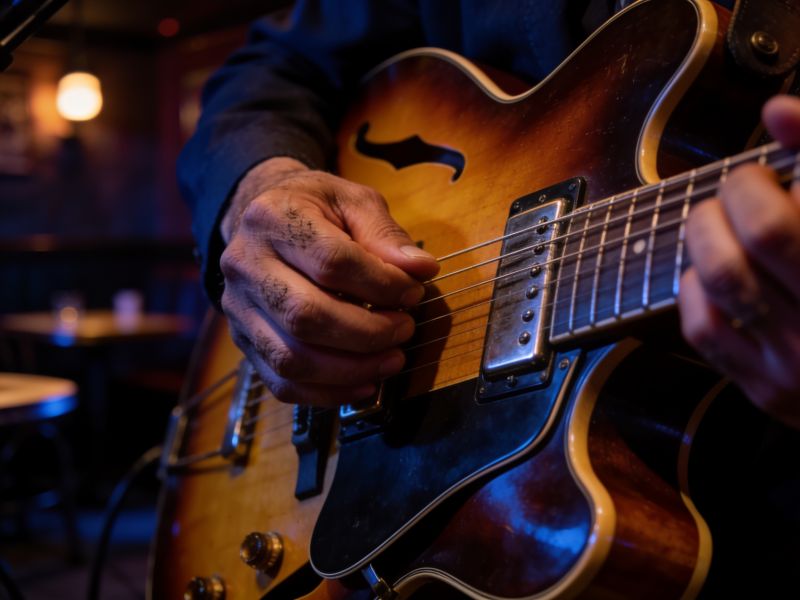
haunting guitar line to a lo-fi hip-hop beat by producer Niles Gray. Each project seems designed to test whether his minimalist language can survive outside jazz. Sometimes it does—the Kade duet album Bare Room is a minor classic of restrained interplay. Sometimes it doesn't;a 2022 guest spot on a rock record felt like a watercolor painting hung in a garage. Louis has said he doesn't mind the misfires. "If I'm the most interesting thing on the track," he told Guitar Quarterly, "then something's wrong with the track."
Teaching occupies half his week. He runs a small studio above a bakery in Brooklyn, and his students—mostly adults who gave up guitar in their twenties—learn to play fewer notes, not more. One exercise he assigns: improvise for three minutes using only two strings and no more than eight pitches total. He calls it "the poverty etude." A former student, now a working session musician in Nashville。told me that exercise broke a decade of pentatonic habits. Louis doesn't advertise. His website is a single page with a PO box and an email address. No bio, no discography, no tour dates. You find out about his gigs through word of mouth or a hand-stamped postcard he mails to a list of about two hundred people.That obscurity is a choice, not a failure. David Louis has turned down two major-label offers and a late-night TV slot. He plays perhaps thirty shows a year, mostly in small rooms with bad lighting and good acoustics. His latest release, a live duo recording with bassist Owen Reeve。was captured on a single ribbon microphone in a Vermont church. It sold three thousand copies. For Louis, that's plenty. The guitar, he's said, is a tool for listening—and listening, real listening, doesn't scale. You either show up to the quiet or you don't.